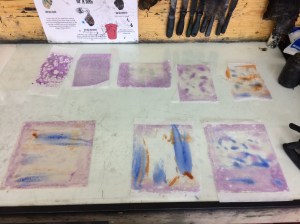
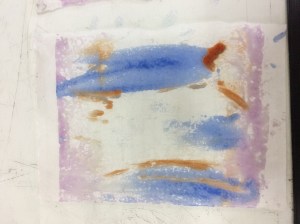
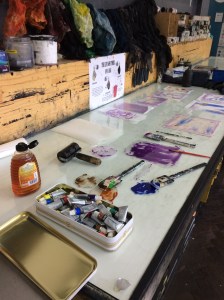
Mono printing with honey The honey is coloured using watercolour paint. Water colour paint is chosen because it is water based like the honey. The colours chosen were the colours Test 1 Japanese rice paper roll. Testing different colours. The colours in lavender plants. The squeezable honey was spread on the glass but when printing from this the honey clumped and formed bubbles. This produced bubbling on the paper so instead the honey was spread on newsprint. This gave the honey a smooth surface. The test paper was pressed on top of the honey by hand. This was done a multiple of times using different colours to build up different layers of honey. The honey on the newsprint was also printed a number of times to leave varying amounts of honey on the paper. Some papers were completely saturated with honey while others had a lot of space left blank on the paper.
Test 2 The same process was done but this time using set honey. There was less saturation of the paper using set honey. The paper was 21gms which meant it was thin enough for the coloured honey to be soaked through to both sides. The drawing is double sided and this enables the mono print to be shaped into three dimensional designs.
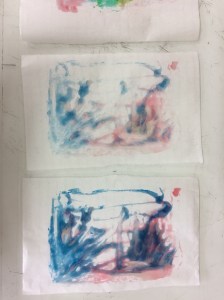
Test 3
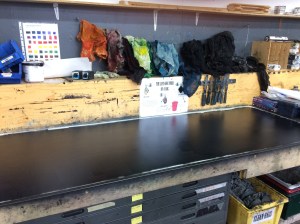
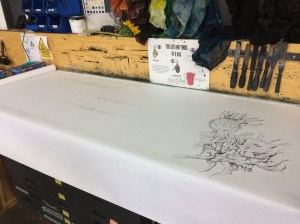
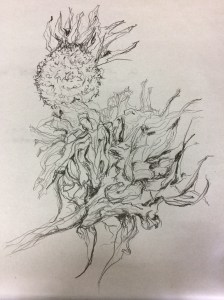
Lines using black etching ink were mono printed onto the paper. A bed of ink was rolled onto the glass, the paper was placed on top of the ink and the lines drawn on the back using paintbrushes, erasers, pencils.
The mono print was then printing again using the coloured honey.
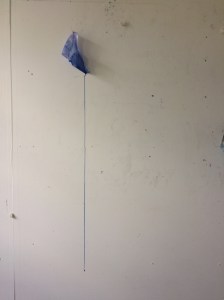
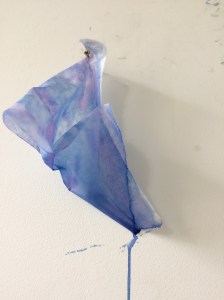
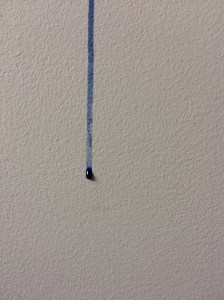
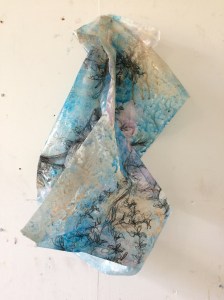
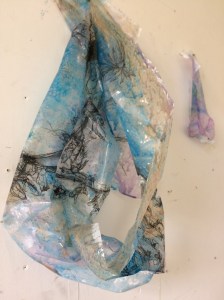
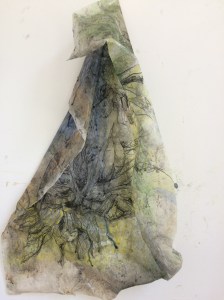
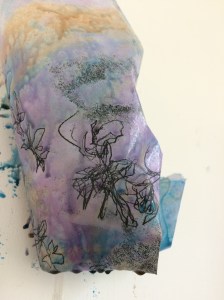
The monoprints were nailed to the wall and the saturated prints shaped and stuck together. Over time the honey ran to the bottom of the monoprint and then down the wall in a line.
Test 4
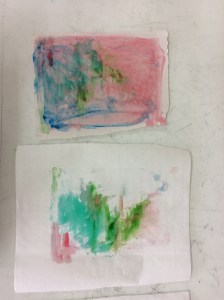
Larger pieces of paper were tested that were 46 gms and 21gms. The monoprint was line drawn using etching ink and then colour printed. When colour printed in light coloured honey the black ink muddied the colour so the first print has to be left longer to dry before the coloured honey is printed. Interesting drips were also formed on the bottom edges of the prints. The honey gives the prints a shiny glazed surface.
 Lucy George